



 Sign-In / Register


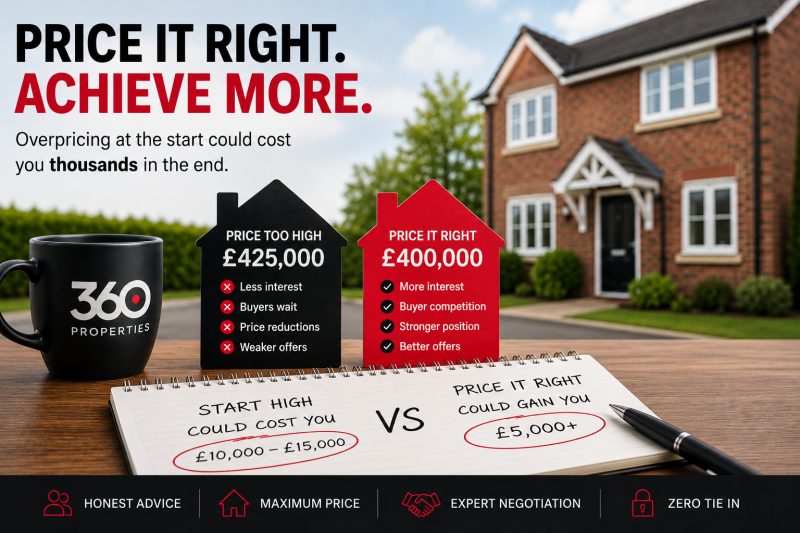
Why testing the market at a higher price could weaken buyer interest, reduce competition and ultimately cost you thousands.
“Let’s Just Try a Higher Price. We Can Always Reduce It Later.”
It is one of the most common conversations we have with homeowners, and potentially one of the most expensive decisions a seller can make.
You have had several estate agents value your property.
One says £400,000.
Another says £410,000.
Then somebody suggests £425,000.
Naturally, the £425,000 valuation sounds appealing. After all, why not test the market? If nobody offers, you can always reduce the price later.
Unfortunately, selling a property does not always work like that.
At 360 Properties, we would rather give a homeowner an honest valuation and risk losing the instruction than suggest an unrealistic asking price simply to get a property onto our books.
Because an estate agent’s job is not to win the instruction.
It is to sell the property and achieve the strongest possible result for the seller.
Your First Few Weeks on the Market Are Incredibly Valuable
When a property first appears online, it has something you cannot easily recreate:
It is new.
Buyers who have been searching for weeks or months receive alerts. They see a property they have not seen before. Other buyers are potentially looking at it at the same time.
That creates urgency.
And urgency creates competition.
Imagine a property has a realistic market value of around £400,000.
If it launches at £400,000 and attracts several interested buyers, those buyers know they may have competition.
Instead of asking:
“How much can I knock off?”
They start thinking:
“What do I need to offer to secure it?”
That is exactly where you want your buyers psychologically.
Three buyers competing for a correctly priced £400,000 property could potentially push the eventual selling price to £405,000 or even higher.
Competition strengthens the seller’s negotiating position.
What Happens When You Launch Too High?
Now imagine exactly the same property launches at £425,000.
Buyers who know the local market compare it with other properties they have viewed.
Instead of seeing value and worrying about somebody else buying it, they think:
“It’s overpriced. I’ll wait.”
That is the problem.
Most buyers do not automatically make a lower offer on an overpriced property. Many simply dismiss it and move on to the next one.
Three weeks pass.
Then six weeks.
The property that once looked new and exciting has become familiar.
Eventually, the asking price is reduced.
Perhaps it goes from £425,000 to £415,000.
Then eventually to £400,000.
But something important has changed.
It is no longer a new £400,000 property.
It is now a property that started at £425,000 and has not sold.
And buyers notice.
We discuss this problem in more detail in our guide to overpricing your home, where we explain why getting the pricing strategy right from day one can have such an impact on the eventual result.
Buyers Start Asking Different Questions
Once a property has been advertised for a prolonged period and undergone price reductions, buyer psychology changes.
Instead of worrying about competition, buyers start asking:
- Why has nobody bought it?
- Is there something wrong with it?
- Is the seller struggling to sell?
- How motivated are they?
- If they have already reduced it once, will they reduce it again?
Suddenly, the negotiating advantage has moved away from the seller and towards the buyer.
That can have a very real financial consequence.
Trying to Achieve £25,000 More Could Ultimately Cost You Money
Consider two different strategies for the same £400,000 property.
Strategy One: Price It Correctly
The property launches at £400,000.
It generates strong initial interest.
Several viewings are booked.
Three buyers become seriously interested.
Competition develops.
The estate agent can then negotiate from a position of strength, potentially achieving £405,000 or more.
Strategy Two: Test the Market at £425,000
The property launches at £425,000.
Viewings are limited.
Buyers wait.
Weeks pass.
The asking price is eventually reduced to £415,000 and later £400,000.
By this point, the property has been online for weeks or months and there is little competition.
A buyer offers £385,000 or £390,000.
They know the seller has already reduced the asking price and they know there are unlikely to be several other buyers competing for the property.
The seller who originally wanted to try for an additional £25,000 may ultimately achieve £10,000 or £15,000 less than they could have achieved by pricing correctly in the first place.
That is the irony of overpricing.
Trying to gain an extra £25,000 at the beginning could ultimately cost you considerably more at the end.
The Highest Valuation Is Not Necessarily the Best Valuation
When choosing an estate agent, it can be tempting to compare the figures each agent gives you and simply choose the highest.
But ask yourself an important question:
Is that genuinely what the agent believes your property will sell for, or is it the figure they believe will win your instruction?
There is an enormous difference.
An estate agent can put almost any asking price on a property.
The real skill is understanding what buyers will pay and then creating the marketing, interest, competition and negotiation needed to maximise the eventual selling price.
This is why we believe sellers should look beyond both the highest valuation and the cheapest commission.
As we explain in our article Commission Minimiser or Sale Price Maximiser?, the figure that really matters is how much money ends up in your pocket when the transaction completes.
Overpricing and Long Tie In Contracts Can Be a Dangerous Combination
There is another factor sellers should consider.
Imagine an agent gives you the highest valuation, wins your instruction and then ties you into a 16 week contract.
The property does not sell.
A few weeks later, the conversation changes:
“We think you should reduce the price.”
You may have chosen that agent specifically because they told you the property was worth more, but you are now contractually tied to them while the asking price gradually comes down.
That is one of the reasons 360 Properties operates with zero tie in.
We believe an estate agent should keep your business because they are delivering, not because a contract prevents you from leaving.
You can read more about our approach in Why Sellers Are Choosing Zero Tie In Estate Agents.
Pricing Is Not About Selling Your Home Cheaply
There is an important distinction here.
Accurate pricing does not mean undervaluing your property.
Our job is to maximise your sale price.
But there is a difference between an ambitious pricing strategy designed to generate the strongest possible result and simply putting an inflated figure online to see what happens.
The objective should be to position your property where buyers see value, encourage as many suitable buyers as possible to view and then use competition and professional negotiation to drive the price.
That is how you create leverage.
And leverage is what helps achieve stronger offers.
Marketing and Negotiation Still Matter
Price is only part of the equation.
Correct pricing needs to be supported by excellent presentation, professional photography, strong online marketing, flexible viewing availability, proactive follow up and experienced negotiation.
The objective is simple:
Create the maximum possible interest in the shortest possible period and turn that interest into competition.
We Would Rather Lose the Instruction Than Overvalue Your Home
This is something we feel strongly about at 360 Properties.
We will always discuss the evidence, comparable sales, current competition and buyer demand with you.
Ultimately, the asking price is your decision.
But if we believe a property should be marketed at £400,000, we are not going to say £425,000 simply because another estate agent has.
That may mean occasionally losing an instruction.
We are comfortable with that.
Because our job is not to tell homeowners what they want to hear.
Our job is to provide professional advice that gives them the best opportunity of achieving the strongest possible outcome.
The Most Expensive Advice Could Be the Highest Valuation
When inviting estate agents to value your home, do not automatically ask:
“Who valued it the highest?”
Instead ask:
- “Why have you valued it at that figure?”
- “What evidence supports it?”
- “What is your launch strategy?”
- “How will you create competition?”
- “What happens if we do not receive the expected interest?”
- “How will you negotiate when the offers arrive?”
The best estate agent is not necessarily the one who gives you the biggest number at the kitchen table.
It is the one with a strategy for turning your property into the strongest possible completed sale.
At 360 Properties, we believe in honest pricing, proactive marketing, professional negotiation and no long tie in contracts.
Because sometimes the highest valuation an estate agent gives you can turn out to be the most expensive advice you take.
Thinking of Selling Your Property?
If you are considering selling and would like a straightforward assessment of what your property could realistically achieve, speak to 360 Properties.
We will explain the evidence behind our valuation, discuss the best launch strategy and show you how we would position your property to generate buyer interest and competition.
No inflated figures simply to win your business. No long tie ins. Just professional advice focused on achieving the strongest possible result.


